
Mercer County Court Records After a Jail Arrest
Mercer County criminal cases run through the Mercer County Circuit Court, part of the 14th Judicial Circuit alongside Henry, Whiteside, and Rock Island Counties. The Circuit Clerk is the keeper of the official record for every case the court hears. So once an arrest leads to a filed charge, the court record sits with the clerk, and that is where the case can be searched, read, and confirmed.
Keep the two sides of an arrest separate. For the custody and booking side, the jail inmate records page covers who is held and how to reach them, and the jail roster mugshots page covers booking photos. This page stays with the court records themselves, meaning the charges the prosecutor filed and how the case moved after the arrest.
The Circuit Clerk's page lists the court's contact details, the Judici case-search link, payment options, and the VINE link in one place.
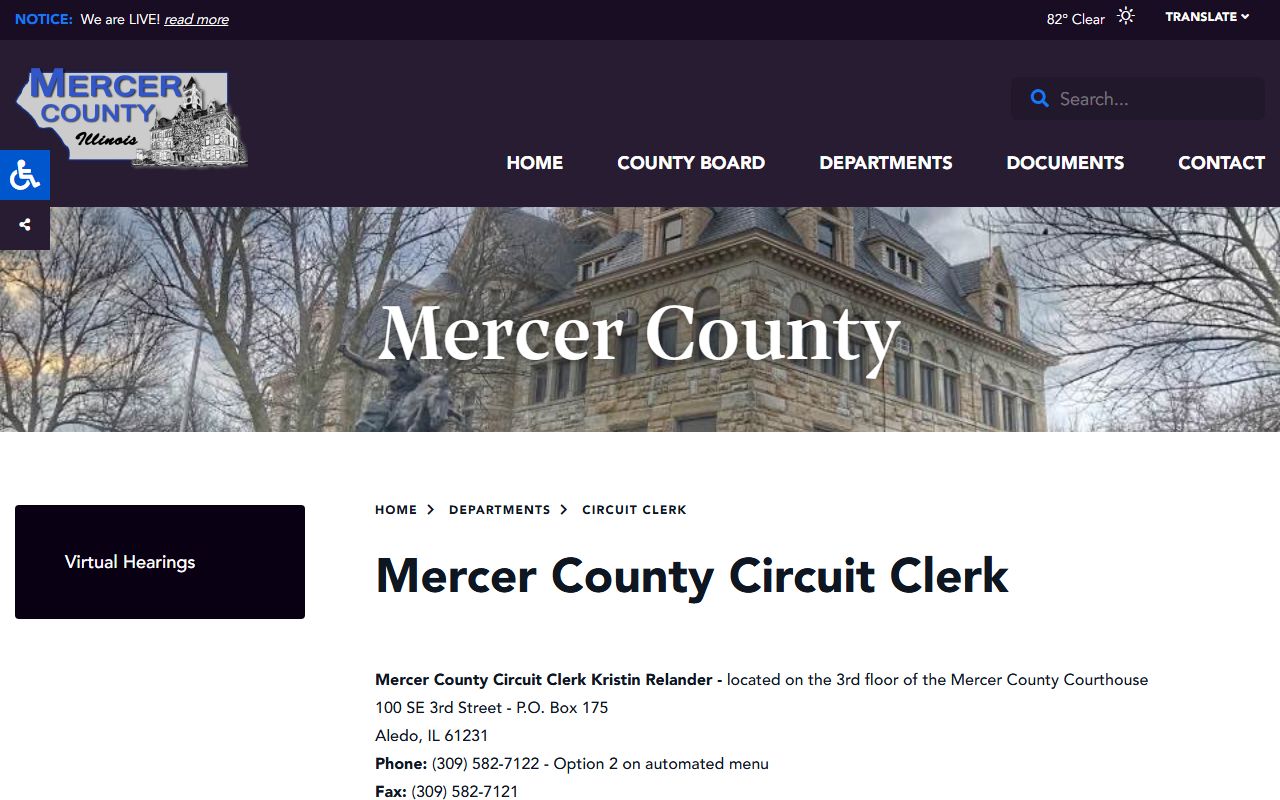
That clerk page is the official hub, which is why a court-record search after an arrest starts there rather than at the jail.
How to Find Mercer County Court Records After an Arrest
The county directs the public to Judici for case searches. The Circuit Clerk links it as the official Mercer County case search. During this review the Judici case-search page was gated behind a CAPTCHA, so the exact live fields could not be fully listed, but the search path is straightforward once you reach it.
- Open the Mercer County Judici case-search page through the Circuit Clerk link.
- Search by the defendant's name or, if you have it, the case number.
- Open the case and read the list of filed charges.
- Check each charge for its class, filing date, and current status.
If Judici will not load or the search stalls, the clerk's counter is the fallback. The Circuit Clerk, Kristin Relander, keeps the official case files at 100 SE 3rd Street in Aledo, and the office is open weekdays from 8am to 4pm at (309) 582-7122. The State's Attorney's office sends people to that same clerk number for court dates, court files, and money owed. For statewide conviction history, the Illinois State Police runs a separate criminal-history check, which under the Uniform Conviction Information Act releases conviction information only. A statewide e-filing portal called Re:SearchIL also exists, but it is separate from the county Judici path and may require registration.
The Judici case-search page is the official portal the Circuit Clerk points to for Mercer County cases.
Because the portal is CAPTCHA-gated, expect to clear a check before the case list appears, and use the clerk's office if access fails.
How Charges Get Filed After a Mercer County Arrest
The court record begins with a charging document. After booking, the State's Attorney reviews the case and decides what to file. In Mercer County the prosecutor is State's Attorney Grace Simpson. The filing can take one of three forms, and the form depends on the offense and the procedure used.
| Complaint | Information | Indictment | |
|---|---|---|---|
| Filed By | Officer or prosecutor | Prosecutor | Grand jury |
| Common For | Misdemeanors | Many felonies | Serious felonies |
| Starts | The case | The case | The case |
The prosecutor files and pursues the charges but does not keep the public court file. The State's Attorney's own page tells people to call the Circuit Clerk for court dates, court-file information, or money owed, which keeps the roles clear.
The State's Attorney page lists the office contact, hours, and where to route court-file and emergency questions.
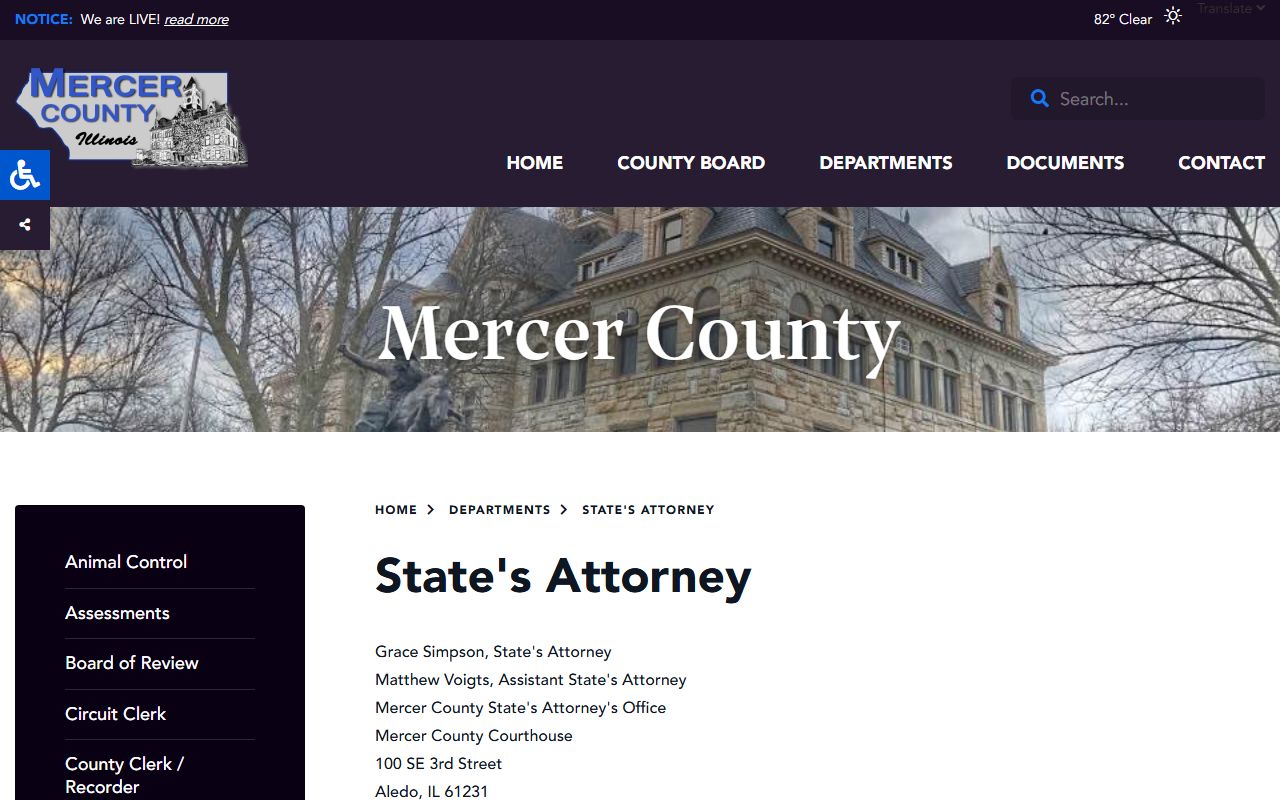
So the prosecutor decides the charge, the grand jury or information starts the felony case, and the clerk holds the record you actually search.
Charge Status in Court Records After an Arrest
Charges are not fixed once filed. As a case moves, a charge can be amended, reduced, added, or dropped. The charge written at booking can also differ from the charge the prosecutor finally files, which is why the court record outranks the arrest paperwork for the formal charge. The common status terms are worth knowing.
| Status | What It Means |
|---|---|
| Pending | The charge is filed and the case is still moving through court. |
| Amended / Reduced | The prosecutor changed the charge or lowered its level. |
| Dismissed | The court or prosecutor ended the charge; it does not erase that an arrest happened. |
| Nolle Prosequi | The prosecutor chose not to pursue the charge. |
Note: A booking charge is what officers recorded at intake, while a filed charge is the court's record, so always read the court file for the charge that counts.
Bond and Release After a Mercer County Arrest
Illinois changed how release works. Under the Pretrial Fairness Act, cash bail is no longer the usual mechanism for a new case. Defendants are presumed eligible for pretrial release, and the State must petition to detain someone under 725 ILCS 5/110-6.1, proving by clear and convincing evidence that detention is justified. When the court orders detention, the person stays in the sheriff's custody pending trial. So an arrest no longer means a person can simply pay a set amount and walk out.
| Path | How It Works |
|---|---|
| Pretrial release | The default; the court may attach conditions. |
| Detention order | The court can detain after a State petition and statutory findings. |
| JailATM payment | Remote bond payment through JailATM.com where the court allows it. |
| Hold / detainer | Another agency's hold can keep a person in custody even after a payment. |
Scams cluster around release. The Office of Statewide Pretrial Services warns that its supervision and GPS services are free and that anyone demanding hundreds or thousands of dollars for release or special programs is not legitimate.
The OSPS Mercer County page explains free pretrial supervision and posts a clear scam warning.
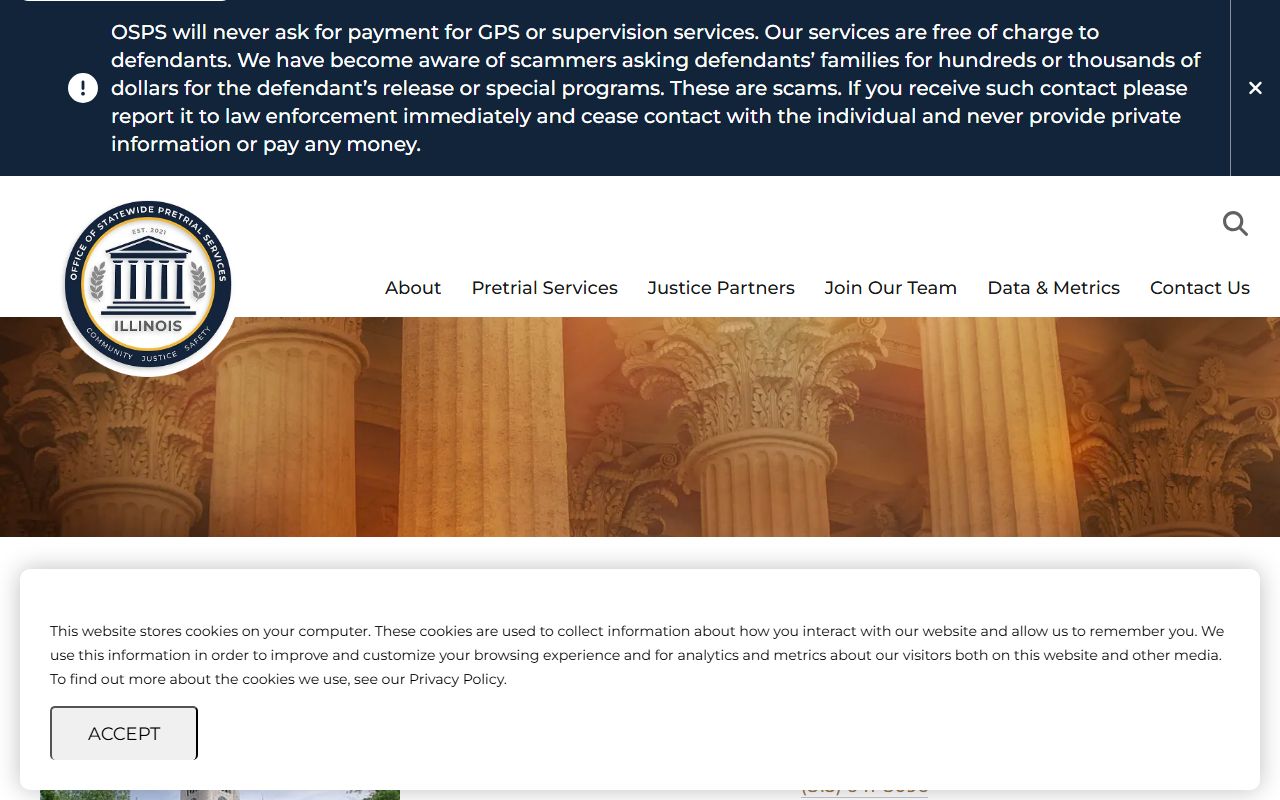
If a caller claims a fee is required for GPS or supervision after an arrest, treat it as a red flag and confirm with the court.
Warrants That Lead to an Arrest
Mercer County does not publish an online warrant list or most-wanted page. For a general warrant question, the sheriff's non-emergency line is (309) 582-5194. For a warrant tied to a filed case, the Circuit Clerk at (309) 582-7122 or the Judici case search is the better route, since a bench warrant shows up in the court record. A written FOIA request to the sheriff can reach records that are public and not exempt.
Warrants come in a few forms, and each reaches the court record differently. An arrest warrant is issued by a judge based on a charge or complaint. A bench warrant follows a missed court date or a failure to comply with a court order, and it shows up in the case docket. A search warrant authorizes a search and is not usually a public "active warrant" item before it is carried out. A fugitive warrant means another jurisdiction wants custody.
An outstanding warrant can turn into a booking at any time. Anyone who believes they have an active warrant should not simply walk up to the jail counter; the safer step is to call the court or sheriff for instructions or speak with an attorney, since an active warrant can lead to arrest. For a state fugitive, the Illinois Department of Corrections offender search runs a wanted-fugitives lookup, and federal matters route to the U.S. Marshals Central District of Illinois.
Charges vs. Convictions
Being arrested and charged is not the same as being convicted. A charge is an accusation that rests on probable cause. A conviction comes only after a plea or a verdict that meets a far higher standard. Both can appear in public records, so reading a charge as guilt is a common and serious mistake.
| Charge | Conviction | |
|---|---|---|
| Stage | Accusation | Plea or verdict |
| Burden of Proof | Probable cause | Beyond a reasonable doubt |
| Public Record | Yes | Yes |
The Illinois State Police conviction-history check, run under the Uniform Conviction Information Act, releases conviction information only, which is a useful reminder that a charge and a conviction are separate things in the record.
Sealed vs. Expunged Mercer County Records
Illinois courts can restrict access to qualifying records through sealing or expungement. The two are not the same. Sealing hides a record from most public view while leaving limited law-enforcement access. Expungement goes further and treats the record as though it never existed. Eligibility depends on the charge and how the case ended, and a dismissal or acquittal often opens the door.
| Sealed | Expunged | |
|---|---|---|
| Visibility | Hidden from most public view | Destroyed or treated as never existing |
| Law Enforcement | Limited access remains | Very limited access |
| Eligibility | Depends on charge and disposition under Illinois law | Often after a dismissal or eligible outcome |
Clearing a court record is separate from removing copies that private sites may have republished. The court process restricts the official record; it does not control third-party reposts.
Background Check Considerations
People often confuse a casual records lookup with a formal background check. A regulated background check follows the Fair Credit Reporting Act and is run by a licensed consumer reporting agency. Reading a public court file for personal knowledge is not that. The two serve different purposes, and the rules that govern them differ.
Important: This is a private reference site, not a consumer reporting agency under the FCRA, and nothing here may be used for employment, tenant, credit, or insurance screening.
Restricted Court Records After an Arrest in Mercer County
Not every record after an arrest is open. Juvenile records are kept separate from adult records and are shielded from public inspection except by proper authority. Sealed and expunged charges drop out of public view. Some dismissed charges can be withheld, and records tied to an ongoing investigation may be exempt under open-records law. When a search comes up empty, a restriction can be the reason, and the court clerk is the office that can explain what is and is not available.
For in-person help, the Mercer County Courthouse offers a self-help center, an e-filing kiosk, a law library, free parking, and language access through Translation Unlimited and Language Line. Those resources support someone reading a court file at the building, though they do not replace the clerk for pulling the official case record.